83rd international concert season 2024-2025
Opening concert: Sofia Sacco (piano)
The 83rd season at Haywards Heath Music Society opened with a piano recital at St Wilfrid's Church.We had been eagerly anticipating welcoming Ignas Maknickas, a multi award winning pianist who is very much in demand.
However, 24 hours before the concert he phoned to say he was indisposed but one of his colleagues, Italian concert pianist Sofia Sacco, was available to stand in for him. And Sofia was a revelation! Her programme was very different to the one we had been expecting. In place of Chopin, Debussy and Schubert we were treated to a dazzling display of pianistic virtuosity in the music of Bach, Clementi, Liszt and Schumann.
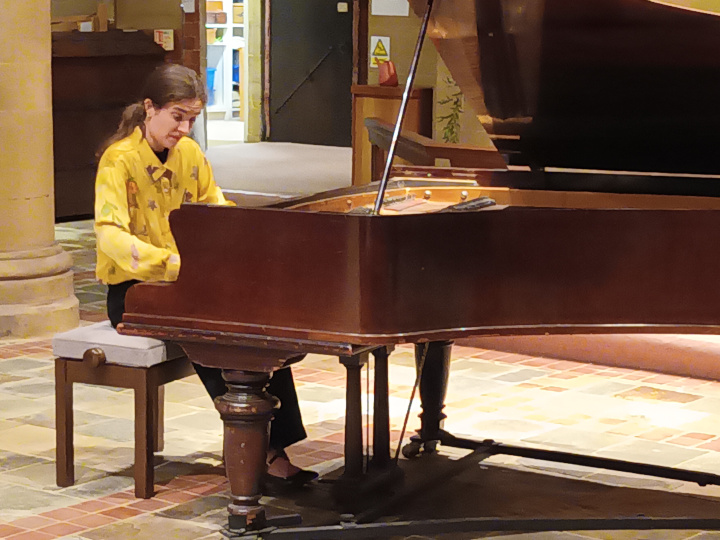
The evening began with a meticulously executed Toccata in E Minor BWV 914 comprising four short movements written to demonstrate the player's technical skills.
There followed a piano sonata by Muzio Clementi. Clementi was a virtuoso pianist as well as a composer of over 100 sonatas which are regarded as more difficult to play than those of Mozart. Most of us only knew Clementi from the simpler Sonatinas and these beautiful slow movements followed by fast and furious Allegros were stunning.. It was not surprising to learn that both Beethoven and Chopin thought highly of Clementi's writing which pushed the boundaries of keyboard technique.
The first half ended with the Concert Etude "Voices of the Wood" and Transcendental Etude" Appassionata" by Liszt. Sofia's playing of these dramatic pieces was masterful, the thrilling sounds rang out around the church and delighted the highly appreciative audience.
The second half began with perhaps the most unusual piece we have heard at the Music Society. This was Black Earth by the contemporary Turkish composer, Fazil Say. The music is based on a popular Turkish song and is written for prepared piano - that is one where the strings have been muted. The intriguing sounds are magical and redolent of the East.
And so to the final work, Carnaval op.9 by Robert Schumann. Here there are twenty one short movements ranging from slow dreamy ones to fast and exciting and describing the Carnival which takes place before the beginning of Lent in some countries. Sofia played the work with great aplomb bringing out the poetry of the different moods.
Sofia has toured extensively in this country and abroad. She wrote to praise the "warm and welcoming" audience and, as all our artists say, she would like to play for us again!
Second concert: Liturina
Saturday 19th October 2024 saw the first afternoon concert at Haywards Heath Music Society. Our October to March concerts will take place at 3pm in the warm, comfortable surroundings of Haywards Heath Methodist Church with its excellent acoustic. The new time and venue proved very popular with the audience!
On this occasion we welcomed the Baroque chamber ensemble Liturina - "a dynamic chamber ensemble dedicated to exploring diverse and challenging repertoire on historical instruments."
Consisting of Iain Hall - recorders, Gabi Jones - violin, Samuel Ng - cello and gamba and Dominika Maszczynska - harpsichord, this group treated the audience to an outstanding display of virtuoso playing. The sound was crisp, vibrant, very well balanced, energetic and gloriously mellifluous! In this feast of Baroque music entitled the Art of the Trio Sonata we heard works by Corelli, Telemann and Bach, plus sonatas by Handel and Marini along with some Purcell.
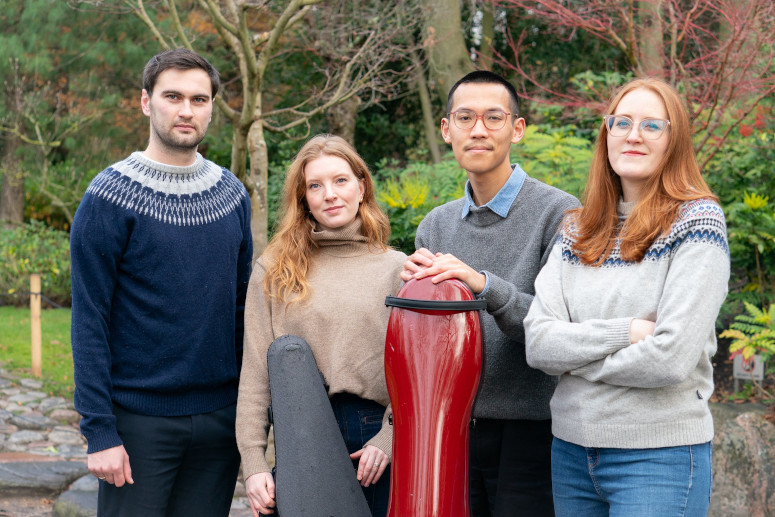
The second half was devoted to works by Bach and demonstrated some intriguing programming. Samuel began with a cello solo playing the Prelude from Suite no.1 which led seamlessly into the Prelude and Fugue in C Minor with Gaby joining Samuel on stage.
Iain and Dominika joined for the transition into the organ trio sonata in G Minor followed by a violin solo - Allemande from the Partita in D Minor, before the group concluded with one of their favourite pieces the Trio Sonata in G major BWV 1039.
The very enthusiastic audience went away delighted with Liturina's wonderful playing and musicianship.
The group is winning plaudits wherever they play and rightly so!
Haywards Heath Music Society is grateful to Making Music and the Philip and Dorothy Green Young Artist scheme for subsidising this concert.
Third Concert: Miriam Teppich, violin and Julian Broughton, piano
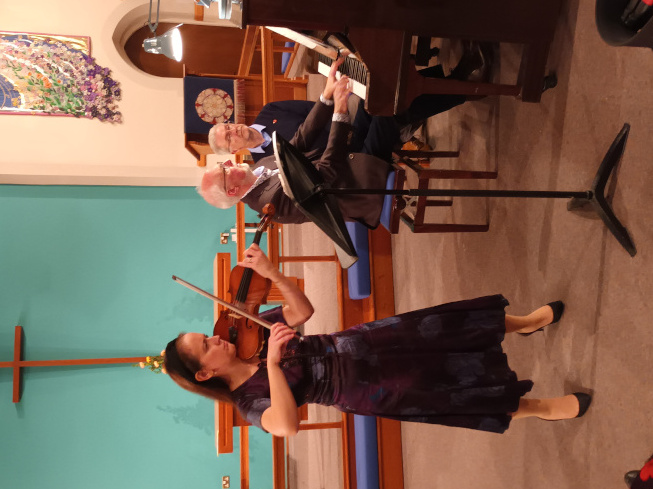
On this Saturday we welcomed the return of a celebrated local duo who first came to play for the Society in 2021.
Miriam and Julian brought a most unusual and varied programme of sonatas for violin and piano by Mozart, Brahms, Prokofiev, Dohnanyi and the modern composer Joseph Phibbs.
From the first sonata, written when Mozart was just 22 years old, to the final work - a Viennese Fantasietta by the Austrian American virtuoso Fritz Kreisler, these two musicians thrilled the audience with their enthusiastic delivery and rapport as their playing adapted to each composer's style in moods and tempi.
They began with the first of Mozart's Mannheim sonatas for Piano and Violin in G major K.301, a joyous, lively piece before switching the mood entirely with a performance of the Violin Sonata (2020) by Joseph Phibbs, an ethereal, reflective and somewhat unsettling elegiac work characterised by soft piano chords fanning out in the opening Prelude.
This was followed by a faster Nocturne with scuttling, pizzicato violin strings, then a slow Ostinato with a single repeated piano line before the work closes in the Blues section
with high pianissimo repeated chords and staccato plucking of the violin strings and a fading to nothing at the end. "Certainly challenging" commented and audience
member in the interval, "...but I liked its modern atonal sounds and a refreshing contrast to the more classical pieces in the programme."
Second half:
After the interval we heard Five Melodies Op.5 by Prokofiev in which Miriam and Julian responded so well to the shifting moods of these lyrical melodies in tonality
and rhythm and the same can be said of their playing of the next piece Sonata for Violin and Piano in C# Minor Op.21 by the Hungarian composer Ernst von Dohnanyi
where their lively interpretation of the Vivace in 3/8 time with its glorious violin tune caps off the work and demonstrated their complete unity in pace and volume.
We edged into the 20th Century with this Dohnanyi work and also lingered awhile in pre-World War One Vienna with the final piece in this concert - the wistful and hugely
atmospheric Viennese Rhapsodic Fantasietta by the Austrian-born American virtuoso violinist and composer Fritz Kreisler. Glorious full violin chords, accordion
like, beckoned us into a tea dance on a lazy afternoon in downtown Vienna. Such is the power of music for sentiment and memory!
Our large audience loved this recital and gave rapturous applause to these brilliant musicians at the end. The decision to stage concerts in the afternoon in the warmth and comfort of the Haywards Heath Methodist Church with its excellent acoustics has clearly proved very popular with all audiences this Autumn.
Fourth Concert: Beth Stone and Daniel Murphy aka "Flutes and Frets"

Haywards Heath Music Society's February concert brought two outstanding musicians to the stage of the Methodist Church.
Beth Stone and Daniel Murphy presented a programme which displayed their complete mastery of a range of instruments seldom heard together in one concert.
Beth is a superlative flautist playing Renaissance, Baroque Classical and Modern flutes. She played every piece in a long demanding programme and seldom seemed to stop for breath!
She was joined in all the pieces by Daniel on the Lute, Theorbo, C19 guitar and Modern guitar. It was probably the case that few in the audience had
ever seen, let alone heard, a Theorbo.
This very large Lute
was introduced to give some depth to the instruments accompanying opera. We all enjoyed its sonorous deep tone.
The programme ranged from C7 plainsong, music for the Masque, Ballet, Opera, a Rossini overture, Morning by Grieg, a fabulous Fantasie on themes from Carmen and Broadway hits.
Such was the enthusiasm shown for these two brilliant performers that we have invited them back to play for us again in a future season.
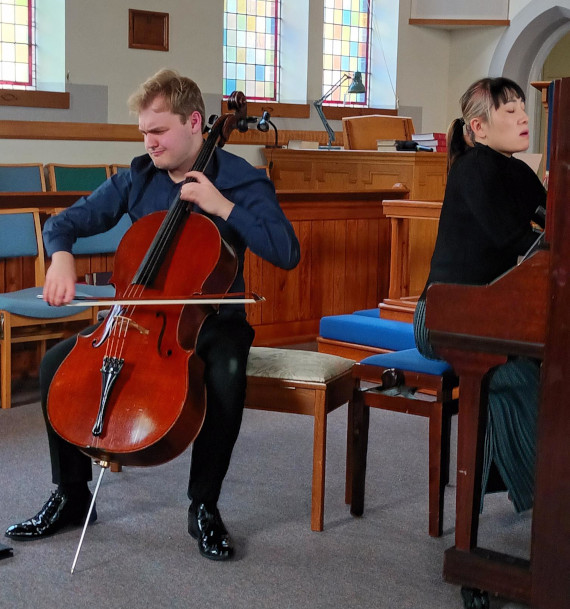
Fifth Concert: Maxim Calver, cello and Kumi Matsuo, piano
Our popular afternoon concert series welcomed two highly celebrated musicians who brought a most interesting and diverse programme of cello and piano sonatas with something lighter in-between. They began with the Andante of Beethoven's Sonata in C Major Op.102 no.1 (1851) in which Maxim set the tone in a leisurely introduction of this beautiful elegiac theme through the deep, rich sonorous sounds of his cello. The pace picked up in the dramatic Adagio where Kumi dazzled with strong rippling runs in the upper register of the keyboard and demonstrated how their tight interactive dialogue impressed our audience in many of the works to come.
In complete contrast came Nadia Boulanger's Three Pieces for cello and piano (1914) which began with a haunting, lyrical introduction on the cello and gentle, rippling piano accompaniment, as a canon between the instruments, then ending with a dynamic, playful piece of rapid, drumming rhythms that changed the mood entirely. Robert Schumann's Adagio and Allegro (1849) followed - a rhapsodic piece with several mood changes - and the players produced a rich resonant sound with intense dialogue between cello and piano.
Second half:
After the interval we were treated to two substantial sonatas for cello and violin by composers whose inspiration was starkly different. First, the Cello Sonata (1915) by Claude Debussy, a technically demanding work requiring Maxim to produce exaggerated percussive left hand pizzicato and spiccato effects (e.g. bouncing the bow) in an impressionistic modal style especially evident in the jazzy, very chromatic Serenade. This led to a flowing and highly animated Finale, quite unsettling, that pushed the boundaries with numerous rhythms and tempi. It is regarded as one of the finest masterpieces written for the cello. The final piece of their recital couldn't have been more different.
Brahm's Sonata for cello and piano no. 2 in F Major Op. 99 (1886) was a full blooded passionate Romantic work with big melodies that boldly suited the sonorous, rich tone of Maxim's cello. The opening Allegro Vivace was a soaring, triumphal movement with cello and piano pitted against each other, followed by a tender and wistful Adagio before ushering in two Allegros; the first with a powerful and dark Scherzo and songlike Trio and culminating in a gracious Rondo and triumphant Coda with some unusual key striking by Kumi. This last glorious work demonstrated how this pair were so perfectly matched in reciprocal response to each other's tempi and volume in all the pieces.
Our large audience was thrilled to hear such a brilliant performance by two young award-winning musicians at the top of their game. It is a pleasure and honour to have such stars as Maxim and Kumi, both in high demand, come to Haywards Heath and play for us and a testament, I believe, to the appeal of our music society to attract the most exciting professional young talent in the land.
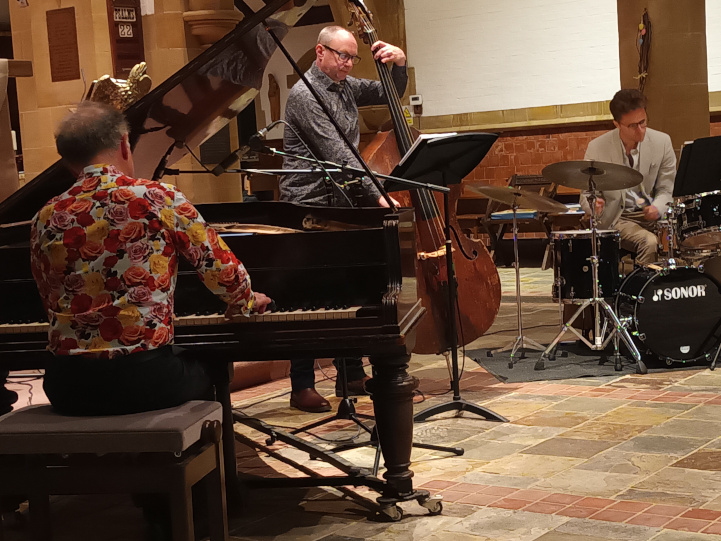
Sixth Concert: The Dominic Alldis Trio
We always end our musical season with something a little different and it often turns out to be an upbeat jazz performance, so we were delighted
to welcome back to St Wilfred's Church the Dominic Alldis Trio who first came to play for us in 2021. The trio comprised Dominic on piano,
Oli Hayhurst on double bass and Justin Tambini on drums. They specialise in jazzing up some fond and familiar classics from JS Bach, Chopin, Tchaikovsky and many others before celebrating the American
greats like Duke Ellington, Cole Porter and Gershwin in a swinging infectious way.
They began with a slow Bach prelude, before Oli picked up the
pace with impressive percussive runs on the double bass, then segued into Jesu, Joy of Man's Desiring followed by Air on a G String, the tune
made famous in the TV advertisement for Hamlet cigars. By now our audience were warming to the cheeky treatment of some of these familiar pieces such
as the Dance of the Sugar Plum Fairy from The Nutcracker and a pepped up version of Erik Satie's Gymnopedie which started in a sober, solid way
before Dominic spun off into some delightful top register arpeggios and quite Arabic sounding improvisation.
All these pieces including Bizet's Farandole from L'Arlesienne suite were
accompanied by Justin's crisp and empathetic drumming as he drove the tight rhythm of the trio forward with his deft brushwork on the cymbals
and neat stickwork on the snare and tom tom drums. Dominic frequently rose from his piano stool to explain the origins of some of the works
they were about to play, throwing in some jokes and reminiscences along the way.
Second half:
In the second half we heard a selection of Dominic's jazz arrangements of childhood themes such as London Bridge is Falling Down and familiar
jazz standards from Ellington and others.
A surprise delight was a whimsical, gently lyrical Largo from Dvorak's New World Symphony and we
ended with some beautifully played Chopin Preludes, notably the C Minor Prelude that demonstrated the sensitivity, polish and precision that
Dominic brought to his keyboard, backed up so ably by Oli's striding double bass and Justin's delicate drumming in-fills.
Our large audience, which included 26 members of the French town twinned with Haywards Heath and Stephanie, the Mayor of Haywards Heath, were thrilled by the Trio's toe-tapping performance and applauded enthusiastically at the end. Jazz music will always feature in our concerts in the future with at least one performance each season.