84th international concert season 2025-2026
Opening concert: Xu Peng (piano)
Our 84th season got off to a dazzling start with a recital by Xu Peng. Xu came to us as the winner of the piano section of the Tunbridge Wells International Music Competition. In addition to this he was voted the overall winner as well.
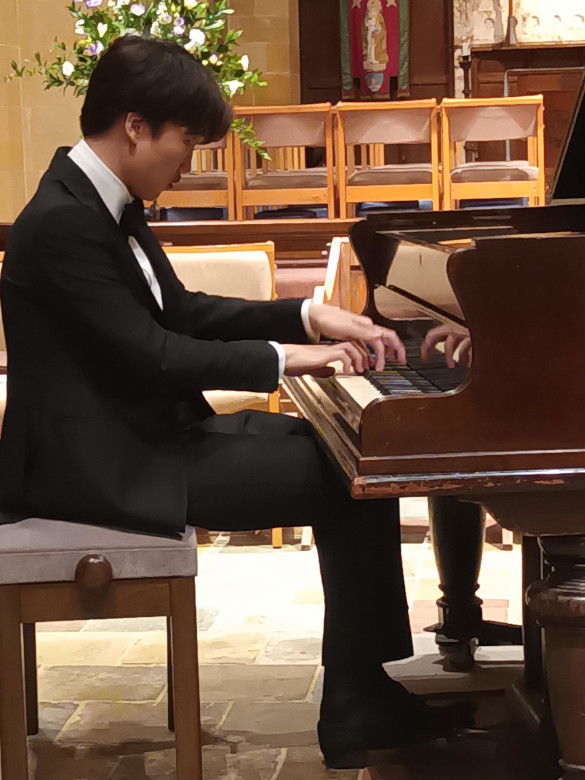
Nearly 300 years separates the music of the two French composers featured in the first half. After a very elegant,
ornamented Chaconne from the Baroque composer Louis Couperin we were transported to the Impressionist world of Claude Debussy.
Xu had chosen to play a selection from Études. Debussy said he wrote these pieces as a warning to pianists not to take up the musical profession unless they have
remarkable hands! He would have had no worries if he had heard Xu, whose hands flew over the keys at breakneck speed all the time demonstrating great variety of touch, colour and mood.
The Études, which are not heard that often, are very programmatic being full of interest with great contrasting content. Debussy's Images opened the second half with the evocative
Reflets dans l'eau bringing out Xu's huge affinity with the composer. The beautiful tone colours which Xu used vividly depicted the image of moving water.
Another passion of Xu's is the music of the English composer York Bowen who wrote in the first half of the 20th century. York was an outstanding pianist, organist, viola and french horn
player and conductor in addition to composing symphonies, concertos, orchestral, cha,mber and instrumental works.
His Romantic style music was very popular in his day, and after hearing Ballade no.2, a piece full of passionate big tunes, the audience's enthusiastic reception showed it is ripe for revival.
The recital concluded with a performance of Chopin's Scherzo no.2 in Bb minor. This dramatic masterpiece is full of lovely melodies interspersed with fast virtuosic passage work.
Xu Peng is an outstanding highly talented pianist with an incredible technique who makes the instrument sing and finds a dazzling range of colours to bring the music to life.
Second Concert: Milo Harper (harp) with Frederico Paixăo (flute) and Angus McCall (cello)
We began our 84th season afternoon concerts by welcoming this newly formed trio who presented a programme of specially arranged works for the harp, flute and cello
by early 20 th Century French, Belgian and Russian composers.
In the first half several pieces were short and unfamiliar to our audience, as were the composers themselves, but we were soon seduced by the tuneful playing of flautist Frederico in
Marcel Tournier's Sonatine Op. 30. as his fingers roved up and down the pads, high and low, to capture the soft, impressionist mood of the piece.
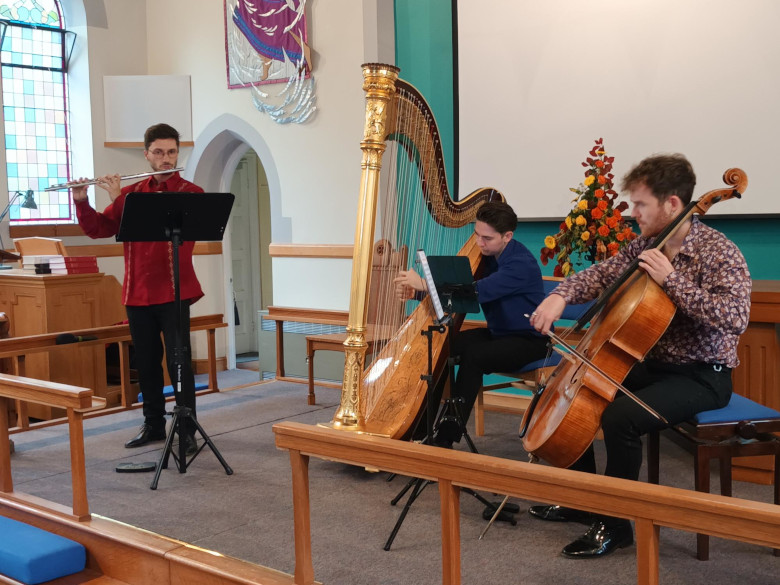
Jacques Ibert's Trio for Violin, Cello and Harp, written during World War II, began with a haunting ostinato in the harp followed by contrasting entries on the cello and flute.
This sad, reflective work, uplifted at the end by the piping of the flute and smooth interplay with the cello, seemed to recapture the emotions of a man experiencing the horrors of
war.
In Lili Boulanger's Nocturne for Flute and Harp we heard a sequence of ascending runs by the flute backed by sensitive stroking of the harp strings. It was a
light, beautiful piece. Deux pièces en trio, Op.80 by the Belgian composer Joseph Jongen followed, contrasting in tempo and mood. These showed off the interplay
between each instrument to perfect advantage from the first slow atmospheric pièce with its languorous, eerie mood to the second one, fast and vivacious.
A melodious Prelude by Shostakovich opened the second half of the recital before our audience was captivated by a beautiful arrangement for flute, harp and cello of the famous
Prélude à l'après-midi d'une faune by Debussy, movingly played by Frederico on flute.
The impressionist mood continued with Song of the Black Swan by Villa-Lobos which pictured a swan
gliding over rippling water - an image repeated in the more familiar The Swan by Saint-Saens, in an arrangement for cello and harp of a
tune that everyone recognised.
Our concert ended with Sonatine M.40 by Ravel, a work of contrasting tempi and moods arranged for flute, cello and harp which started
with a passionate first movement followed by a tender, charming minuet and culminating in a vivacious finale.
What we heard tonight were three musicians who magnificently combined, with their distinctly different instruments, to play works that touched the hearts, not just of the
composers who wrote them, but also of our audience. Milo, Frederico and Angus showed a virtuosity and sensitivity to the others playing that was quite magical and
they are sure to go on to wonderful things in the future as a trio.
Our audience loved this recital and gave rapturous applause to these brilliant musicians at the end. We
look forward to inviting them back in the future.
Third concert: Liturina (Baroque ensemble)
It was a great pleasure to welcome Liturina to perform again at Haywards Heath Music Society. Just over a year ago the group performed a programme of Baroque music to great acclaim from the large audience. Following many requests we invited them back to play a completely new programme for us exploring the spread of the French baroque style across Europe in the C17 and early C18.
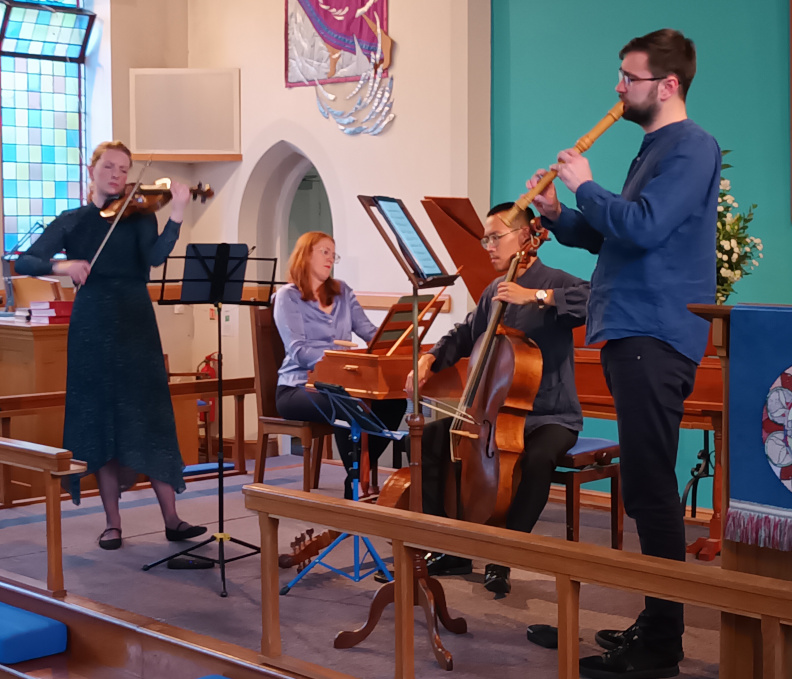
The line-up consisted of Iain Hall (recorders), Gabi Jones (violin), Samuel Ng (viola da gamba) and Dominika Maszczynska (harpsichord).
Taking Couperin's instrumental music from Les Nations as the starting point, the programme ranged over wonderfully tuneful and vibrant music from Lully (Chaconne des
Scaramouches), Leclair (Deuxieme Récréation de Musique), Telemann (Quator partisien no.1), Boismortier, (Sonate Op. 50 no.6) to a French Suite by J S Bach and ending in
England with music from our own Henry Purcell's Fairie Queen.
All of this was played impeccably and with great assurance. The audience's enthusiastic reaction gave no doubt as to the appeal of the joyful Baroque era.
Fourth Concert: The Fibonacci Quartet
What a wonderful quartet! The Fibonacci Quartet gave us a concert which will live long in the memory. I have to say I have never heard string playing like it.
Comments have included "the best string quartet concert ever", "from the first moments of their playing it was electrifying", "a fantastic concert, quite amazing" and from everyone
"please get them again"!
The group played three quartets from different eras and in very contrasting styles. First up was Beethoven's Quartet Op.18 no.1 written in 1800 on the cusp of the Romantic era.
Watching the Quartet one was struck by the passion, vibrancy and energy of their playing and the resulting gorgeous depth of sound.
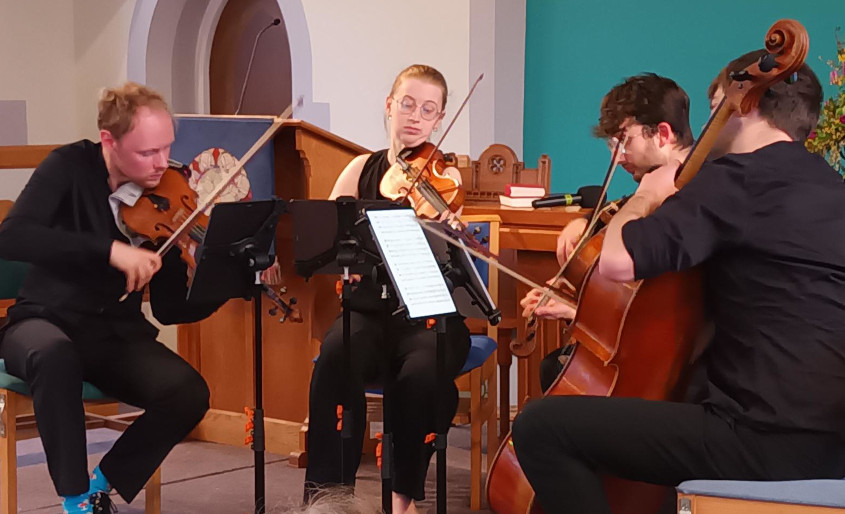
Next came Debussy's only string quartet where the
music took on the shimmering sound of the Impressionists. The delicate quiet pizzicati of the second movement suggested the influence of Eastern music. The dreamy, mesmerising
sublime slow movement played with exquisite control led to a lively last movement with carefully built climaxes.
Lastly we heard Schumann's Quartet no.3 in A Major, a work which shows the composer at the peak of his powers. The playing here showed Schumann's tender side, the sound quality was warm,
the playing full of emotion.
I think we were all aware that these musicians are in a league of their own and set a very high benchmark for other groups to aspire to. They have won first prize in numerous International
competitions and appeared at the top venues in Berlin, Vienna, Hamburg, Paris, London to name but a few. One runs out of superlatives in describing this group!
Many thanks to the Munster Recital Scheme and YCAT for enabling us to have such a wonderful concert. The ensemble, power, depth of tone, complete mastery of the technical demands,
mood and, above all, consummate musicianship make the Fibonacci totally outstanding.
We are used to appreciative audiences at our concerts but I have never before heard the spontaneous outburst of cheering and
rapturous applause which greeted the end of the first piece - the Beethoven, then the Debussy and Schumann.
Fifth Concert: Baroque Alchemy - The Golden Thread
On a sunny afternoon in March our packed audience in the Methodist Church were treated to a dazzling display of virtuoso recorder and keyboard playing by Piers
Adams and Lyndy Mayle who brought their brand-new programme The Golden Thread to our eager ears - modern variations on Baroque pieces linked through the
genius of JS Bach.
The journey opened with a fiery transcription of the Allegro from Bach's Sonata in A Minor BWV 1003 for violin followed by a soulful, tender Tristan's Lament and a
vibrant Saltarello from the medieval world. This established the pattern of many of the pieces in the first half where familiar works like Bach's Prelude in C Minor, played
in a lively, driven way by Lindy on keyboards, was complemented by Piers's, at times jazzy, recorder, before relaxing into warm, mellifluous solo runs and unexpected
turns of phrase as in Uccellini's haunting La Luminia Contenta.
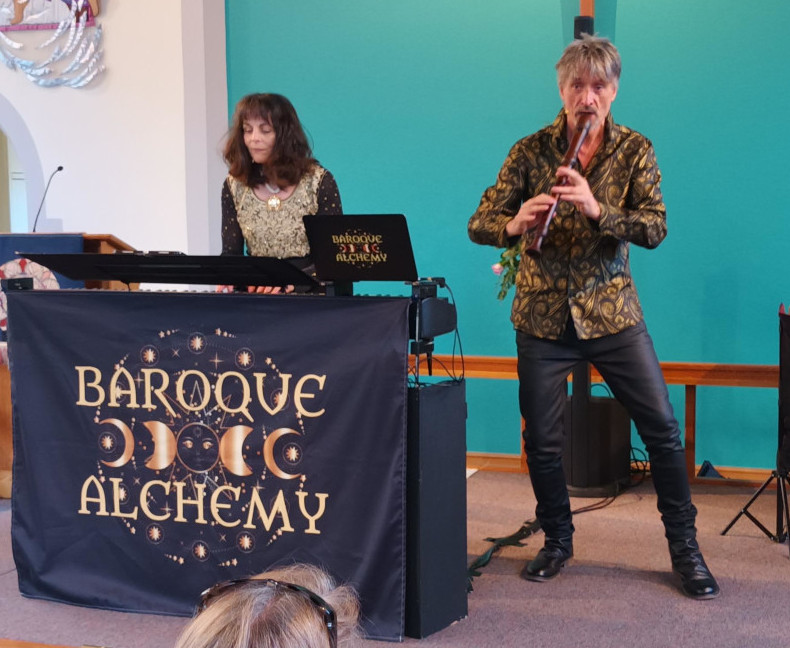
Each section in this first half closed with pieces of strongly contrasting tempi as in Massenet's beautifully, lyrical Meditation from Thais and Debussy's atmospheric and fluid Syrinx,
adapted from the flute version by Piers.
His lively explanations of the origins of these works created an atmosphere of sheer delight for both performers and audience and no
more so than when Piers mimicked the quirky sounds of farmyard and domestic animals for Biber's Sonata Representiva on his many recorders and whistles.
Drawing these instruments from behind him, Piers paced about the stage exuding charm and charisma, wowing the audience with energy and gusto.
Bach's Adagio from Sonata in E Minor BWV 1034 continued the thread after the interval. Lyndy improvised with a harmonious G minor Prelude from the 17th century
harpsichordist Louis Couperin and spoke about his short-lived genius. Piers piped on a curious horn to evoke distant landscapes in a haunting medieval Cathar hymn
before a trio of movements adapted from Bach's G Major cello suite restored courtly poise and rhythmic vitality to the section.
Linde's Music for a Bird saw Piers trilling up and down in a piece that demonstrated how Bach's spirit of experimentation still resonates today into the 20th century.
The programme closed with Monti's virtuosic Czardas played by the duo in a blaze of colour and dash before our audience cheered and called them to return for an encore of Copland's Fanfare
for the Common Man.
It was a joy to see such a spirited dialogue between the performers and their chosen music that engaged both Piers and Lyndy of Baroque Alchemy and
our audience so completely. Fun and vitality spread throughout the afternoon and we look forward to welcoming them again in the future.
Sixth Concert: Trio Archai
Our 84th season of International concerts came to a triumphant conclusion on Saturday April 25th with a stunning recital by the multi-award winning Trio Archai.
Ayala Sahin (violin), Finn Mannion (cello) and Mar Valor (piano) chose a programme of trios by Beethoven and Brahms introduced by a modern work "Nocturnes" by the BAFTA award composer
Jeremy Sams. This piece, especially written for the group, was quite different from the music usually associated with C21 composers. It was gentle, melodious and evoked a relaxed night time mood.
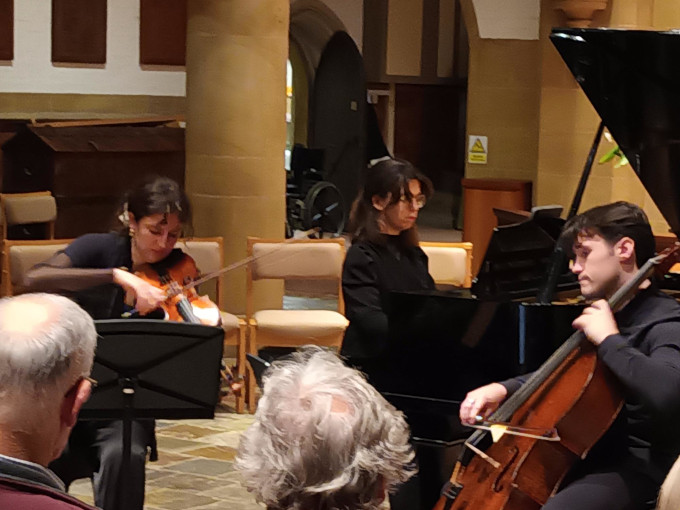
On to the two major works of the evening. First up was Beethoven's Trio in Eb,Op.1 no.1. An energetic Mannheim rocket of fast rising arpeggios all impeccably delivered led us through the joyful
work. Trio Archai play with disciplined ensemble, attack, verve and, indeed, move as one , proving this is a Trio of outstanding quality.
After the interval Trio Archai continued with Brahms Trio Op.8 which led us into the Romantic era.
The group produced a sumptuous sound combined with impassioned playing which received an enthusiastic response from the highly appreciative audience.
Trio Archai won first prize at the prestigious Royal Overseas League Competition, have given a Wigmore Hall recital and have a residency at Snape Maltings this year.
Clearly they are a group to watch and we are delighted that they played for us in Haywards Heath.